Wednesday, 21 January 2015

Ch 6: The Last Word on Evil: The Second Horseman

"And out came another horse, bright red.  Its rider was permitted to take peace from the earth so that people should slay one another, and he was given a great sword."  Rev 6:4

I attend an Anabaptist church.   Its foundation is built upon Christ-like response to individuals,  to the community and to the world.  There is no justification for violence of any kind, says the Church.  There is no  such concept as Just War.  I am not quite there yet.

John L. asked us to consider Augustine's "Just War" argument. Here are Augustine's Principles of Just War and a Catholic apologetic

My natural self wants to accept the Just War Doctrine.   Surely there must be times when we can ignore Jesus' command not to resist evil.  Yet, an Anabaptist, or any Christian pacifist, would say that no Christian should act violently against another person.
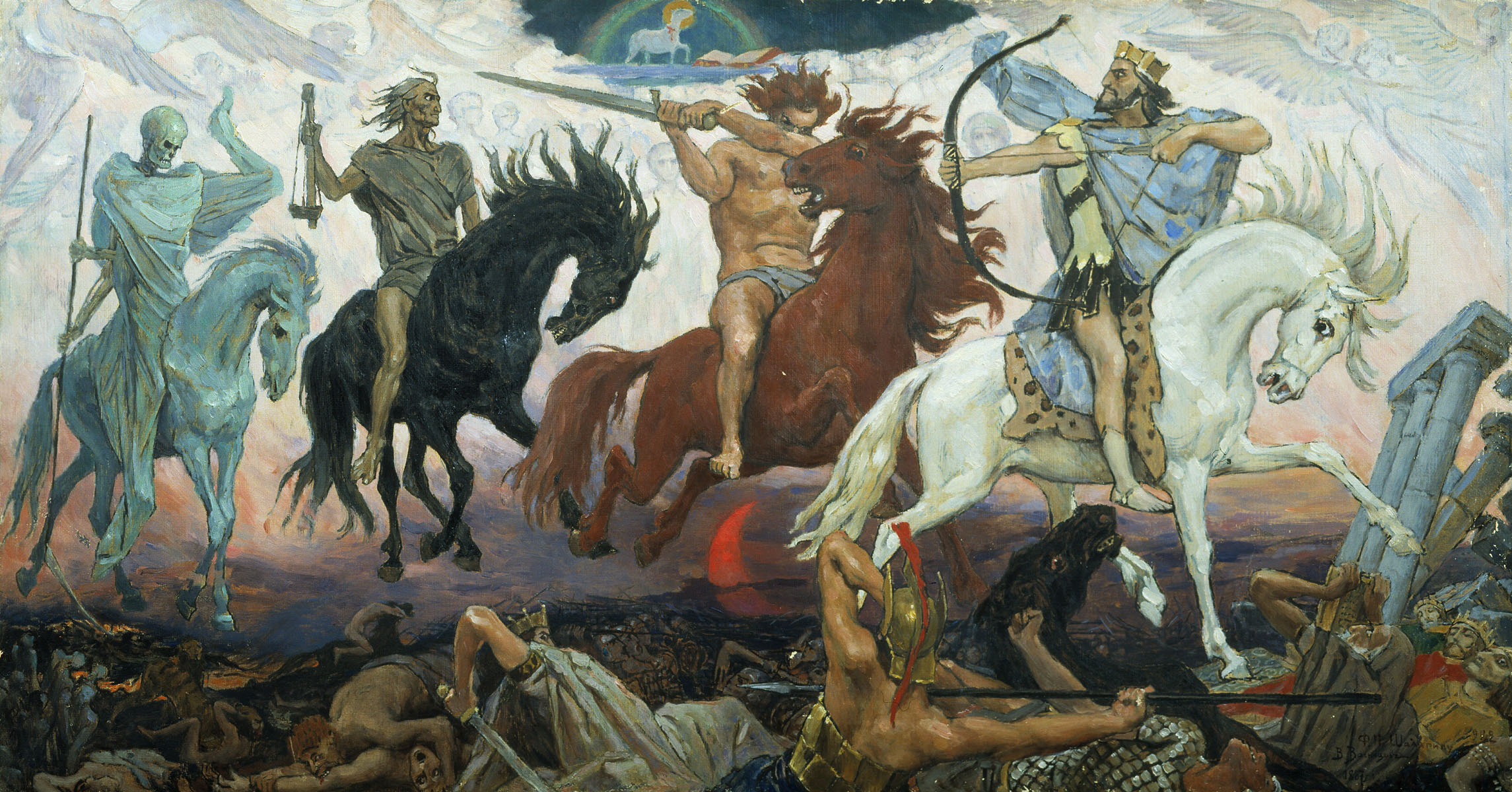
At the same time a Christian pacifist might say  that governments are God-ordained institutions.   God created it for a purpose, knowing that it  would promote evil and violence from time to time.   Government will do violent things.  Let the government do the violent things. (It is likely true that all governments tend to be despotic).    Let Christians not participate in violent activity.

Such a position taken by certain Anabaptists could be seen as hypocritical.  The anabaptist will avoid violence and at the same time enjoy the protection of a violent government.  Indeed, I have heard it said that one cannot be a Christian and also be a politician, for inevitably a politician must make a decision whether the country should go to war.

Here is how I rationalize the dilemma.

At the personal level I understand that I am not to act violently and must not resist evil, in a physical sense at least.  How would I react in defence of my family?  I pray that such a question will remain a hypothetical one.

God has indeed ordained the institution of government.   In a democratic state we have delegated up to Government -- the Chief Magistrate -- the authority to intervene on our behalf in order to limit violence and to deal with the violent.  In this way, the citizen does not have to and should be proscribed from committing violent acts against his or her fellow citizen.

Further, the Chief Magistrate is vested with the responsibility of ensuring that the State is stable, so that the citizenry be not at risk, nor be it unruly.  There are times when the Chief Magistrate will determine that it must go to war.

It is my preference that the Government be populated by Christians who will wrestle with  the awesome responsibility of waging Just War.   I do not agree that Christians should not participate in parliament, join police forces, or volunteer to defend the citizenry.    If we are going to commit the sin of violence,  I prefer that thoughtful peace loving Godly persons who know what Jesus thinks of evil would make those terrible decisions and play those difficult roles.

This matter is so complex and weighty that I cannot develop arguments for or against Just War any more than that written above.  So, I will leave it at that and look forward to your responses.


Monday, 12 January 2015

The Last Word on Evil: Rev 6&7: Some thoughts on John's Post

The prevalence of evil in the 1st & 2nd Centuries was indeed incomprehensible; however it is doubtful that it was greater than the evil we see today.  Neither one nor the other is more incomprehensible; instead, evil is incomprehensible in every generation in which it is manifested.   There is evil we can clearly identify; there is evil which we do not recognize; there is the evil we perpetuate -- all incomprehensible.

The seals must be opened by the One Who is worthy and by no other.  Without Christ opening the seals, we cannot make sense of history or our purpose for living.  He stands before evil knowing and letting us know that evil is overcome.

Evil is a fact.   Stoical religions such as Judaism and eastern Christianity accept that evil abounds.    Western Christianity is somewhat utopian in nature, sometimes expecting our relationship with Christ to banish evil in our lifetime. The secular society in which we live is even more so, holding to the belief that Man can defeat evil.
So, when evil continues to prevail, we  ask, "Where did this evil come from?  Why does God allow it to persist?"   The real question is perhaps, "What are we going to do about it?"  Christ says "come to me" (Matt 11:28) and "love your enemies"  (Matt 5:44).  Maybe that is what we should do about it.

Christ is not the source of evil nor does he permit it.  On the eternal scale, the evil one has already been defeated, is being defeated, and will be defeated.


Friday, 9 January 2015

Chapter 6 The Last Word on Evil
Background
4 I wept and wept because no one was found who was worthy to open the scroll or look inside. 5 Then one of the elders said to me, “Do not weep! See, the Lion(E) of the tribe of Judah,(F) the Root of David,(G) has triumphed. He is able to open the scroll and its seven seals.”
Read Revelation Chapter 6 and 7
The immediate historical context of the book of Revelation is that evil prevailed in a way that we cannot even comprehend today. Christians were dying on crosses, for entertainment in the coliseum and in prisons. John knew evil.
What do you make of the fact that in the vision the lamb of God, Christ, opens seals containing evil.
Is Christ saying there will be evil?
Does Christ permit evil?
Of course remember Job
What is the first horse
Christ
What is the significance in the first horse?
War is the human condition. To be human is to war. The first element in the war is a conquering Christ. Page 75 . Biblical Christians do not sentimentalize Christ. There is a fierceness and a militancy here. The world is in conflict and; our Christ is the first on the battle field. The white horse is not a signal that Christ has given up on donkeys and crosses but rather a statement that Christ will be triumphant.
Evil is summarized in three horsemen of war. What are they?
Red horse – war
Black horse – famine
Pale horse – Sickness unto death
Peterson “ The perennial ruse is to glorify war so that we accept it as a proper means of achieving goals. But it is evil.” Do you agree?
What about Augustine  just war
Do the words of rider of the black horse reflect the growing reality of today’s world? Page 77
It would seem that there is a growing disparity between rich and poor in our western world.
Peterson spiritualizes the message of the rider of the black horse. Do you agree with his premise? Page 78
Do you agree with Peterson that modern technology disguises sickness? Page 79
His words seem a little off to me.
Modern technology does give an illusion that the evil of sickness is solvable and takes away our dependence or even turning to Christ. When you get a headache do you go to the medicine cabinet or do you first seek Christ in prayer. 
What does the fifth unsealed disclose?
Religious persecution on a scale unimaginable in Canada
What is the message for us today?
Page 81 “Christians, for the most part are the very persons in our society who can be counted on to have no illusions about the depth of depravity in themselves or in the world today.” Do you agree?
ACTS praying
The unveiling of the sixth seal seems to release the most calamitous of events. Describe them and the result?
What do you make of the description of the events as the wrath of the lamb?
Who can withstand?
Christians
Why does a good God permit evil?
Page 85.

38 For I am convinced that neither death nor life, neither angels nor demons,[k] neither the present nor the future,(CD) nor any powers,(CE) 39 neither height nor depth, nor anything else in all creation, will be able to separate us from the love of God(CF) that is in Christ Jesus our Lord.(CG)